Emergency Broadcasting
Quiet Listening: Radio, Headphones and Late Hours
A guide to quiet listening for community radio fans: late-night programming, low-volume headphones, and calm audio habits at home.
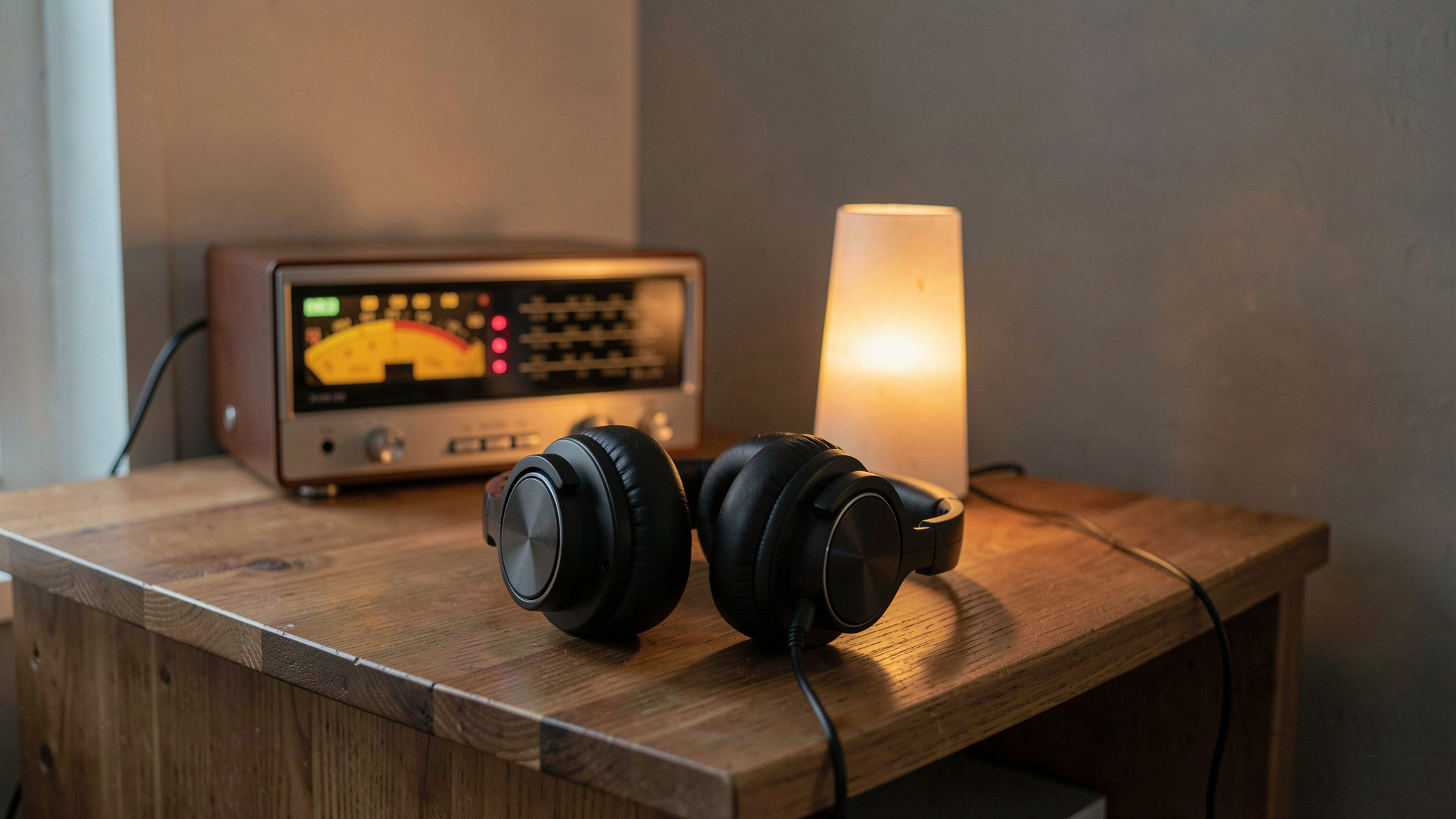
Quiet listening means treating low volume as a deliberate practice rather than a compromise. It asks for programming built for late hours, headphones that stay articulate at low levels, and a room arranged so that nothing competes with the sound. Community and LPFM stations can serve that audience with slow, spoken, or ambient blocks that reward attention instead of demanding it.
Why does late-night radio sound different?
Late-night radio is not simply daytime radio played later. The audience is smaller, the room is darker, and the listener is often alone. Hosts slow down. Music beds stretch out. Talk segments get longer and quieter, because there is no commute to shout over and no office to arrive at.
A station that programs for those hours makes a few practical choices. It lowers the average loudness of the mix so that speech and music sit at similar levels. It reduces the number of hard transitions, since a sudden jingle at 1 a.m. is jarring in a way it never is at noon. It also accepts silence as a valid element, letting a track fade rather than cutting it.
For LPFM operators, this is a cheap format to produce and a distinctive one to schedule. A single host with a small music library can fill two or three hours without a large budget, and the result sounds intentional rather than empty.
What belongs in a quiet listening setup?
A quiet listening setup is mostly about removing friction. The goal is that a listener can start a program, adjust the volume once, and then stop touching the equipment.
Three elements matter most. First, headphones that keep their detail at low output, since many models lose bass and texture when the volume drops. Second, a source chain without clicks, hums, or level jumps, because small noises become prominent when everything else is soft. Third, a comfortable position, usually reclined, with the device within reach but not in the hand.
Streaming has made this easier and harder at the same time. It is easy because a phone and a pair of headphones are enough. It is harder because notifications, autoplay, and compression all interrupt the mood. A station that publishes a clean, continuous stream with a stable level does its late-night listeners a real service.
A useful reference point for this kind of slow, curated listening is the material collected at liedschatten.com, which gathers calm music, open sound spaces, and the equipment that carries them into a living room. Its sections each follow a single question, from music that helps with falling asleep to headphones that still have something to say at low volume.
Is quiet listening only for sleep?
No. Sleep is one use, but not the only one. Quiet listening also covers reading, studying, recovering from illness, working through a difficult evening, or simply being in a room with another person who is also awake.
The common thread is that the listener wants company without stimulation. Radio is well suited to that role because it is continuous and impersonal. It does not require a decision at the end of every track, and it does not track attention the way a video feed does.
Stations can serve this audience by labeling blocks clearly. A program described as calm, slow, or instrumental will find the right listeners. A program described only by genre will not, because the same genre can be played loudly or softly, and the late-night audience is choosing the second option.
How does a station program for low-volume listening?
Programming for low volume is a production discipline. It starts with monitoring. If a show is mixed on loud speakers, it will sound thin and uneven when played quietly. Checking a mix at low level, on headphones and on a small speaker, catches problems that a loud check hides.
Compression should be gentle. Heavy compression raises quiet passages and flattens the dynamic range, which is exactly what a late-night listener does not want. Speech should be recorded close to the microphone so that it does not need to be pushed up later.
Scheduling matters too. A quiet block placed after a loud music show will feel like a relief. The same block placed after a talk program may feel like more talk. Building a nightly arc, loud to soft, gives listeners a reason to stay tuned as the evening moves on.
What about the rest of the evening?
The same hour can be filled in very different ways. In many households the evening belongs to the television, and a summer format built for a shared, loud, fast experience sits at the opposite end of the same time slot. That contrast is worth acknowledging rather than arguing about. A station that serves quiet listeners is not competing with the television. It is offering the other direction of the same hour.
This is also why quiet programming tends to attract loyal listeners rather than large ones. Someone who has found a program that fits a specific, recurring need, such as winding down after a late shift, will return to it. That loyalty is more valuable to a small station than a broad but indifferent audience.
Do headphones matter more than speakers at night?
At night, headphones usually matter more, for two reasons. The first is practical: they keep the sound out of the rest of the home. The second is technical: they deliver detail that a speaker cannot at the same low level, because the driver sits close to the ear.
The trade-off is comfort. Headphones that sound good for twenty minutes may be painful after two hours. Weight, clamping force, and ear pad material become as important as frequency response. Open-back designs often feel cooler over long sessions, while closed-back designs block more room noise.
For a station, the practical implication is simple. If a show is intended for late-night headphone listening, it should be checked on headphones. Stereo placement, sibilance, and low-level hiss all behave differently there than on speakers.
How does quiet listening fit community radio?
Community radio has an advantage here. It is not required to chase the largest possible audience in every hour, and it can afford to serve a small group well. A nightly quiet block, a weekly ambient show, or a slow reading program costs little and gives the station a recognizable identity after dark.
It also builds a bridge to listeners who are not able to engage with loud or fast media, including older listeners, people with sensory sensitivity, and anyone working night shifts. Those audiences are rarely served by commercial schedules.
The technical side is modest. A stable stream, a consistent level, and clear program descriptions do most of the work. The rest is a matter of respecting the hour and the listener's attention.
What should a listener try first?
Start with one program and one pair of headphones, and change only one thing at a time. Set the volume lower than feels natural, then wait a few minutes. Most people find that the ear adjusts and that detail returns.
Then remove interruptions. Turn off notifications, disable autoplay, and keep the device plugged in so that the session does not end with a battery warning. If the room is noisy, closed-back headphones help. If the room is quiet, open-back headphones are usually more comfortable.
Finally, treat the schedule as part of the experience. Knowing that a calm block begins at a certain hour turns listening into a routine, and routines are what keep small stations alive.