Radio History
From pirate transmitters to LPFM licenses
The low-power FM service was not a government idea. It was the government’s answer to a decade of illegal transmitters that kept turning themselves back on.
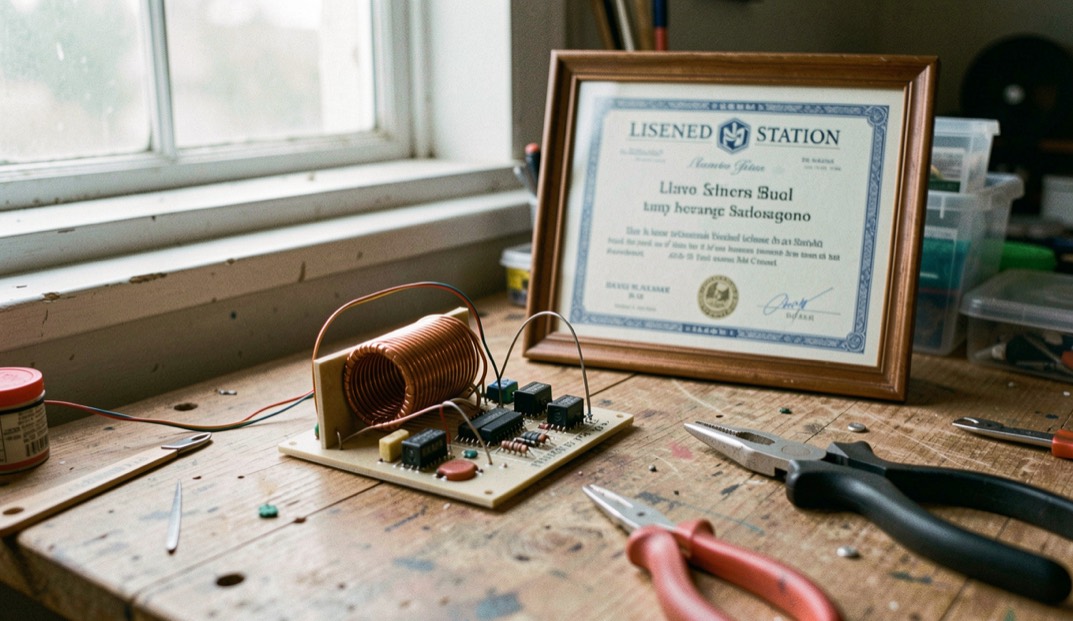
In the late 1980s, in a Decatur, Illinois housing project, a tenant activist named Mbanna Kantako began broadcasting a watt or two of community news and civil rights programming from his apartment, after the city moved against him and his neighbors and no licensed station in the area carried their story. Black Liberation Radio was illegal from its first day, and it kept broadcasting anyway. Across the country through the following decade, hundreds of similar microstations went on the air without licenses: neighborhood stations, immigrant-language programs, anarchist reading hours and church services, powered by handbuilt transmitters of ten to a hundred watts, defying an FCC whose rules offered no legal slot smaller than thousands of watts of obligation.
Free Radio Berkeley and the courtroom phase
The movement found its engineer and its lawyer-friendly loudspeaker in Stephen Dunifer, whose Free Radio Berkeley built inexpensive transmitter kits and trained community groups to use them from 1993 onward. The FCC moved to silence him, and the resulting litigation, running through the middle 1990s in the Ninth Circuit, put the government in the awkward position of arguing that a First Amendment license scheme could leave no space smaller than a commercial station. The courts did not hand Dunifer a blanket victory, but the fights stalled enforcement and, more importantly, made the policy case public: there were communities with no station of their own, and the rules simply refused to let them exist. By the decade’s end the Commission could no longer pretend the microbroadcasters were a rounding error. The petitions of the movement, joined by established advocates, produced the rulemaking that ended in the FCC’s January 2000 creation of the low-power FM service: 100 and 10 watt noncommercial licenses, exactly the scale the pirates had demonstrated.
What the movement proved
The pirates’ argument was never really about electronics. It was about the map: communities with no station of their own, subjects no licensee would schedule, languages the commercial dial ignored, and a regulatory structure that priced every remedy above a volunteer’s reach. The microstations documented demand the official record lacked. When the FCC finally studied low-power service in the late 1990s, testimony from community groups, engineers and even some established broadcasters filled a docket the movement had spent a decade preparing for, and the resulting order credited the experiments as evidence that small noncommercial signals could coexist with full-power neighbors. That is the unlikely shape of the story: civil disobedience turned into a rulemaking record, and the record turned into a service whose selection criteria still privilege exactly the small, local, uncommercial applicants the transmitters represented.
The compromise, and the long correction
The 2000 order came with shackles, attached by Congress in the Radio Broadcasting Preservation Act: the third-adjacent channel ban, whose geometry quietly eliminated most channels in urban areas, told in technical detail in the protections guide. The movement responded the way it had learned to, with evidence and organizing. The Prometheus Radio Project, founded in Philadelphia in 2002 by veterans of the pirate era, sued and organized until the Local Community Radio Act was signed on January 4, 2011, removing the third-adjacent ban. When the FCC finally opened the October 2013 window, the first in thirteen years, more than 2,800 applications arrived, many from exactly the neighborhood and school groups the 1990s transmitters had imagined: the calendar of that window and its successors is told in the window guide.
The story matters because it explains the service’s soul. LPFM’s rules favor local applicants, its licenses cannot be bought on the open market beyond one per organization, and its channels cannot be sold to the highest bidder, all because the service was built to legitimize a movement rather than to expand an industry. Every time a licensed station replays its first legal sign-on, the Armstrong lineage of stubborn engineering and the pirate lineage of civil disobedience meet on the same dial position. The stations did not win the right to broadcast by waiting for it. A licensed station inherits the obligation to carry the community’s calendar, as our guide to civic events on air describes, and the listener’s side of the bargain, patient attention, is trained in our guide to the discipline of listening.