Radio History
Armstrong and the invention of FM
Every 100-watt station on the dial owes its existence to one stubborn engineer who proved that static was not inevitable, and who paid for the proof with everything he had.
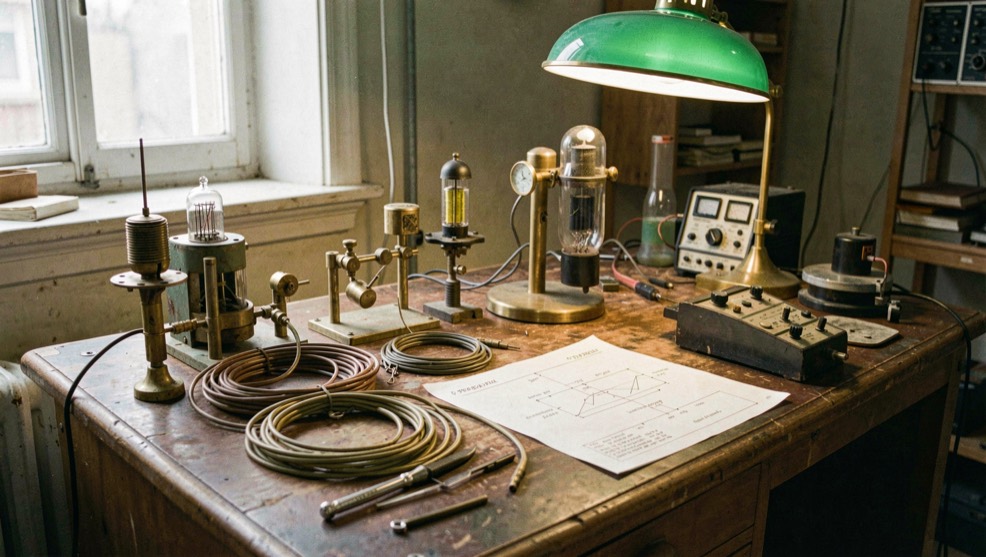
Through the 1920s, radio came with weather. Amplitude modulation, the technology of every commercial station of the era, delivered thunderstorms into every living room, and the industry’s best engineers regarded static as a law of nature. Edwin H. Armstrong, the inventor whose regenerative and superheterodyne circuits had already made radio practical, refused to accept the law. Working through the early 1930s, he demonstrated that carrying a signal on the frequency of the wave rather than its amplitude, frequency modulation, swept static aside entirely. His basic FM patents were granted in 1933, and in public demonstrations in the mid 1930s, including a famous presentation to the Institute of Radio Engineers, listeners heard clean reproductions of music and voice through a storm. The era of high-fidelity radio begins there.
The industry that fought the future
Armstrong’s relationship with the radio establishment turned from profitable to poisoned. RCA, which had licensed his earlier inventions and whose television program depended on the amplitude band, declined to develop wideband FM and directed its research toward television; the manufacturer argued, publicly, that FM offered little advantage. Armstrong built his own proof: an experimental station and a tall tower at Alpine, New Jersey, transmitting across the Hudson into New York, where critics could compare FM against the AM giants directly. The sound settled the argument for listeners, and after the FCC authorized commercial FM broadcasting, the first regular stations took the air in the early 1940s on the band then allocated between 42 and 50 MHz.
Then came the decision that shapes this magazine’s beat. In 1945 the FCC moved FM upstairs to the 88 to 108 MHz band, a reallocation urged in part by interests invested in the old frequencies, and every early FM receiver, transmitter and listener investment on the original band became obsolete overnight. Armstrong fought the order and the patent fights that surrounded it for the rest of his life, through infringement suits the industry litigated for years. He died by his own hand in 1954. History’s verdict arrived too late to console him: courts and the industry eventually recognized the value of his work, and his widow continued the legal campaign to its conclusions. The band he fought for is the band this magazine covers, from the reserved educational channels described in the campus band guide to the low-power channels licensed since 2000.
The band grows up
FM’s recovery after the band move was slow, then decisive. The war deferred receiver production, post-war sets arrived with the new dial, and through the 1950s the frequencies filled with beautiful-music stations, classical outlets and experimenters. In 1961 the FCC authorized stereo broadcasting on FM, using a pilot-tone system that layered a second channel into the existing signal, and music listeners with upgraded receivers discovered what Armstrong’s wideband deviation had made possible all along: a quiet channel wide enough for two. Campus stations, religious broadcasters and the first listener-sponsored voices colonized the band’s edges through the 1960s, and by the time the LPFM service was imagined, FM had become the dial’s most desirable real estate, which is precisely why the fight over its empty corners mattered so much.
Why the invention matters to community radio
FM gave community broadcasting two gifts. The first is technical: static-free sound made small stations worth listening to for music and speech alike, which is why the volunteer programmers in our 100-watt listening guide can be understood as heirs of the Alpine transmitter. The second is structural: because FM was a young service with unfilled channels after the 1945 move, educational and noncommercial applicants could win real frequencies, a fact the FCC cemented by reserving the bottom of the new band for education. The culture that grew on those reserved channels, told in the campus guide above, and the listener-sponsored experiment begun in 1949, told in our Pacifica history, both stand on Armstrong’s invention.
There is a lesson in the biography for every founding group dreading the filing window: the dial’s rules are written by institutions, and they change when stubborn people document the truth until the institutions cannot deny it. Armstrong lost the years and won the band. The community stations that followed, from the pirates of the 1990s to the licensed LPFM service, have been running his play ever since. The archive instinct runs from the Alpine tower to a village blog, as the village chronicle lesson preserves, and the craft half of the inheritance is the cut, given vocabulary in our guide to editing radio like a film editor.