LPFM Rules Made Simple
What 100 watts buys on the FM dial
One hundred watts is a light bulb with a license, and the size of its footprint is not an accident but the central promise of the low-power service.
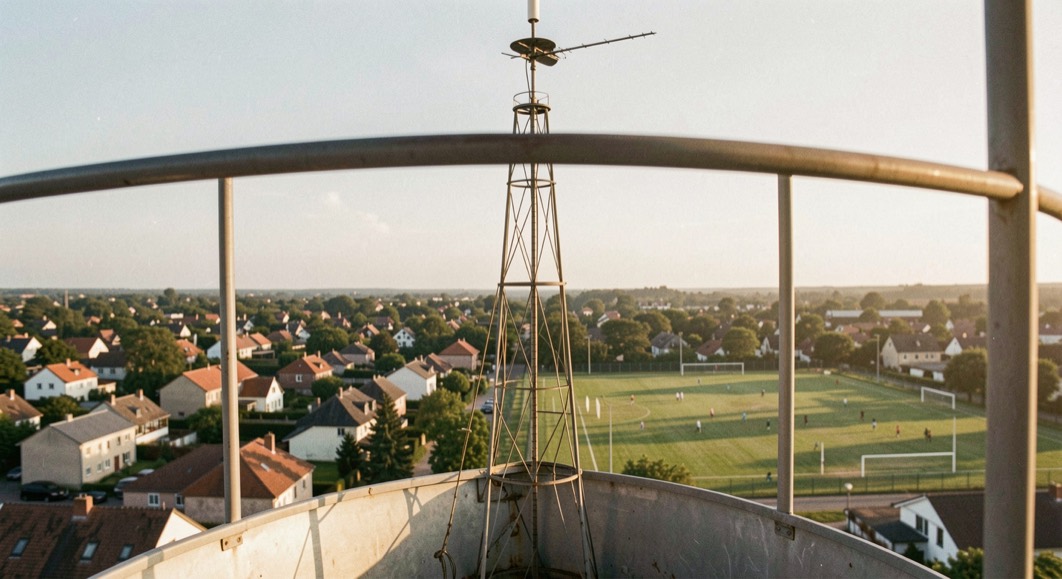
The number that defines low-power FM is written on the license: 100 watts, effective radiated power, from an antenna no more than 30 meters above average terrain. That is the ceiling of the LP100 class, and every question about coverage starts there. Radio amateurs will point out that a hundred watts carried by a tall commercial tower could blanket a region, and they are right, which is exactly the point: the FCC fixed both the power and the height, so the footprint of an LPFM station is deliberately, permanently local. The service was created in January 2000 to put neighborhoods on the air, not to create small versions of commercial stations, and the 30-meter antenna ceiling is what keeps that promise honest.
The radius, honestly stated
In flat, forgiving terrain, a full LP100 station delivers a reliable signal across a radius of roughly three and a half miles, which is enough to cover a small town, a dense city neighborhood or a college district with margin. Hills, metal buildings and skyscraper canyons cut that figure; a favoring site beside a modest ridge can stretch it. The 10-watt class that the FCC also created at the service’s birth, intended for tiny communities and institutions, serves a mile or two and is rarer today. Volunteers should treat all such mileage as planning figures rather than boundaries: the accurate way to size a station is the engineering study filed with the application, and the startup roadmap places that study in sequence. What no group should expect is suburban sprawl coverage; the protection rules that keep an LPFM clear of its neighbors also keep its ambitions geometrically sane.
Why small is the design, not the defect
The local footprint is what makes the programming local. A signal that ends at the county line belongs to the people inside it: its underwriters are the shops on one main street, its sports hours cover one school district, its weather matters to one microclimate. Bigger coverage would dilute exactly that. It also shapes reception culture: listeners describe the station as something their street receives, and the practical listening advice in our sound of a 100-watt station guide follows from the physics, from the value of a rooftop antenna to the way the signal drops off between two intersections.
The rules reinforce the design. Because the service is noncommercial, no advertiser will ever pay for a larger footprint, which removes the incentive to engineer around the ceiling. Because licenses go to local applicants under the point criteria in the point system guide, the licensee is expected to live inside the contour. And because the band from 92.1 to 107.9 MHz is shared with full-service broadcasters, the small footprint is what allows a community signal to fit between neighbors at all, a negotiation described channel by channel in the protections guide.
Planning like an engineer, dreaming like a neighborhood
Receiver quality completes the picture, and groups should plan for the receivers their community actually owns. A good car radio or a modern receiver with a real antenna hears the full contour comfortably; a phone-sized transistor radio or a clock radio on a metal shelf may lose the edge blocks even though the engineering study is satisfied. That gap is not a flaw in the license but a fact of the band, and it argues for streaming companions and patient expectations during the first year, as the podcast workshop and the listening habits in the sound guide both describe.
A three-and-a-half-mile radius argues for a studio inside the community rather than twenty miles away, for a transmitter site with the antenna above local rooftops rather than behind the hill that would hollow the signal, and for an online companion, such as the streaming and podcast habits in the podcast workshop, to carry special programming beyond the contour. It also argues for patience during the channel search: the town next door may offer the only clean 100-watt opening in the county, and a community of license a few miles away still counts as a local signal to the people it reaches. One hundred watts buys exactly one community’s worth of broadcasting. That is what it was designed to buy, and in the hands of a good group it is enough.